How to install a French drain: trench depth, stone, and fall
A French drain is not complicated. It is a sloped trench, a perforated pipe, and a lot of clean stone. Almost every failed one fails for the same three reasons: not enough fall, the wrong stone, or nowhere for the water to actually go. This guide works through those three numbers first, then the install.
Start here: is a French drain the right fix?
This is worth five minutes before you rent a trencher, because drainage problems have different causes and a French drain only solves some of them.
| What you are seeing | Likely fix |
|---|---|
| Water sits in one low spot after rain | Regrading may be cheaper. A drain works if you cannot raise the low spot. |
| Water runs toward the house across the yard | Fix the grade first. A drain is a second line of defence, not a substitute for slope. |
| Seepage at a basement or crawlspace wall | French drain at footing depth, plus check gutters and downspouts first. |
| Soggy lawn over a wide area, no single low point | Often a soil or compaction problem. A drain may do very little. |
| Water building behind a retaining wall | Drainage is part of the wall build. See the retaining wall guide. |
| Downspouts dumping against the foundation | Extend the downspouts. Cheapest fix on this page, and often the only one needed. |
If your problem is in the first or third row, keep reading. If it is the last row, go move your downspouts and save yourself a weekend.
The three numbers that decide whether it works
Everything else is digging. These three decide the outcome.
1. Fall: at least 1 percent
Fall is the slope of the pipe from the high end to the outlet. The working minimum is 1 percent, which is 1 foot of drop per 100 feet, or 1.2 inches per 10 feet. State drainage specifications and university extension guidance both use 1 percent as the practical floor for subsurface drain lines.
| Run length | Fall at 1% | Fall at 2% |
|---|---|---|
| 10 ft | 1.2 in | 2.4 in |
| 20 ft | 2.4 in | 4.8 in |
| 30 ft | 3.6 in | 7.2 in |
| 40 ft | 4.8 in | 9.6 in |
| 50 ft | 6.0 in | 12.0 in |
| 100 ft | 12.0 in | 24.0 in |
Take more fall if the depth allows it. The consequence of too little is not a slow drain, it is a trench that stores water permanently.
2. Depth: deeper than the water you are intercepting
There is no single correct depth, which is why most answers online are useless. The pipe has to sit below the water you want to catch.
- Surface water in a lawn: 18 inches at the high end is a sensible start.
- Protecting a foundation: the pipe usually needs to reach footing depth, because water above the pipe drains to it and water below it does not.
- Behind a retaining wall: the pipe sits behind the base course, inside the stone chimney.
Remember the trench gets deeper as it runs. A 40 ft drain starting at 18 inches finishes at roughly 22.8 inches once you build in 1 percent fall. Budget for that when you plan the outlet and the spoil pile.
3. Stone volume: clean #57, and more than you think
The trench is mostly stone by volume, and stone is the line item that surprises people. The calculation is the trench volume minus what the pipe displaces.
A 4 inch pipe occupies about 0.0873 square feet of cross-section, so it displaces roughly 0.09 cubic feet per linear foot of trench. On short runs that is almost noise. On long runs it is worth subtracting.
Worked example: 40 ft trench, 12 in wide, 18 in deep
- Trench volume: 40 × 1.0 ft × 1.5 ft = 60.0 cubic feet
- Pipe displacement: 40 × 0.0873 = 3.49 cubic feet
- Stone needed: 60.0 − 3.49 = 56.5 cubic feet
- In cubic yards: 56.5 ÷ 27 = 2.09 cubic yards
- In tons at 1.4 tons per cubic yard: 2.93 tons
- Add 10 percent for settling and over-dig: order about 3.2 tons
| Trench | Stone (cu ft) | Cubic yards | Tons |
|---|---|---|---|
| 20 ft × 12 in × 18 in | 28.3 | 1.05 | 1.47 |
| 30 ft × 12 in × 18 in | 42.4 | 1.57 | 2.20 |
| 40 ft × 12 in × 18 in | 56.5 | 2.09 | 2.93 |
| 50 ft × 12 in × 18 in | 70.6 | 2.62 | 3.66 |
| 30 ft × 12 in × 24 in | 57.4 | 2.13 | 2.98 |
| 30 ft × 18 in × 24 in | 87.4 | 3.24 | 4.53 |
| 50 ft × 18 in × 30 in | 183.1 | 6.78 | 9.50 |
Figures exclude waste. Density is taken at 1.4 tons per cubic yard, the same default the calculator uses. Ask your supplier for the density of the specific stone you are buying and use that instead if they give you one.
Enter the trench length as the length, the trench width as the width, and the depth as the depth. Subtract about 0.09 cubic feet per foot for the pipe.
Why it has to be clean stone, not crusher run
This single choice decides whether the drain works at all, and it is the one homeowners most often get wrong at the yard.
#57 stone is washed angular stone, roughly 3/4 inch, with the fine particles removed. The voids between the stones are the whole point: they are the path water travels to reach the pipe.
Crusher run is angular stone with fines deliberately left in, so it compacts into a dense, solid layer. That is exactly what you want under a slab or a paver base, and it is the opposite of what a drain needs. Put crusher run in a drainage trench and you have buried an expensive, water-blocking wall.
The same distinction runs through the gravel calculator and the base guide, where the requirement is reversed: there you want the fines, because compaction is the goal.
Aggregate sizing is defined in ASTM C33, the same standard that governs the coarse concrete sand used for paver bedding. If a yard does not recognise "#57", ask for washed 3/4 inch clean stone with no fines.
The fabric question, answered properly
Most guides say "use landscape fabric" and move on. The detail matters, because the wrong fabric actively causes the failure it is supposed to prevent.
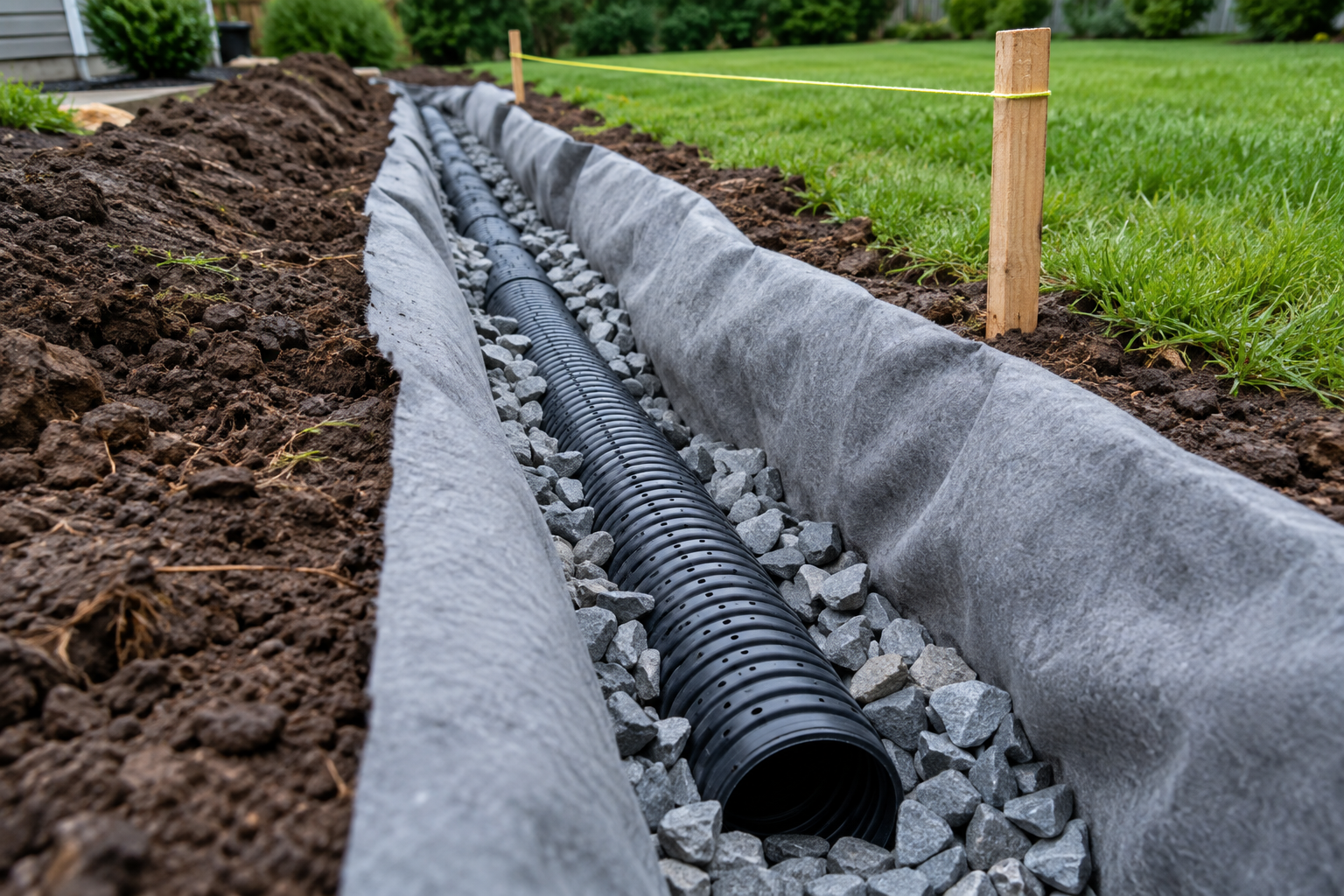
Use non-woven geotextile. It is a felt-like fabric that passes water through its thickness while holding back soil particles. Woven fabric, the black plastic weave sold for weed suppression, is the wrong product: it sheds water rather than passing it, and it clogs.
Wrap the stone completely, sometimes called a burrito wrap: fabric across the trench floor and up both walls, stone and pipe inside, then the loose edges folded over the top before backfilling. Silt migrating into the stone is the normal long-term failure mode of a French drain, and a full wrap is what delays it by years.
| Trench | Fabric width needed | Approx. area |
|---|---|---|
| 20 ft × 12 in × 18 in | 5.0 ft | 100 sq ft |
| 40 ft × 12 in × 18 in | 5.0 ft | 200 sq ft |
| 50 ft × 18 in × 24 in | 6.5 ft | 325 sq ft |
Width allows for the trench floor, both walls, and about 12 inches of overlap at the top.
One exception worth naming: some installers skip fabric in clean, sandy soils where silt migration is minimal, on the basis that fabric is itself a future clog point. In clay or silty soil, wrap it.
Pipe: 4 inch, perforated, holes down
Four inch perforated pipe handles typical residential yard and roof runoff. Step up to 6 inch on runs beyond roughly 100 feet, or where several downspouts feed one line.
Lay the holes facing down. This is counter-intuitive enough that plenty of drains are installed upside down. Water arrives through the surrounding soil, fills the stone bed from the bottom, and enters the pipe through the lowest openings. Holes facing up means water has to rise through the entire stone bed before it can enter the pipe at all, so the trench holds water that should already be leaving.
On rigid versus corrugated: rigid PVC is smoother, flows better, and is easier to keep on grade. Corrugated flexible pipe is cheaper and faster around curves but sags more easily, and a sag is a low point that collects silt. If you use corrugated, be careful about bedding it evenly.
Skip the pre-wrapped sock pipe in silty soil. The sock clogs at the pipe itself, where you can never get at it, whereas a trench-wrapped fabric clogs far more slowly across a much larger surface.
Where the water actually goes
This is the part people plan last and should plan first. A French drain does not make water disappear, it relocates it, and it needs somewhere legitimate to arrive.
- Daylight outlet: the trench runs to a point lower than its start where the pipe opens onto a slope. Simplest and most reliable option when the ground allows it.
- Pop-up emitter: a spring-loaded lid at grade that opens under water pressure. Useful on flat lots where there is no slope to daylight into.
- Dry well: a buried stone or chambered reservoir that holds water and lets it soak away. Appropriate where soil percolates well and nowhere lower exists.
- Storm system connection: permitted in some municipalities and prohibited in others. Check before you assume.
Two rules that are not optional. Do not discharge onto a neighbour's property: in many areas that creates real liability. And call your utility locating service before digging, because drains are shallow enough to find irrigation lines, low voltage lighting, and sometimes gas service.
The install, start to finish
- Find and confirm the outlet, then work backwards from it. If there is no viable outlet, the rest of the plan does not matter.
- Run a string line from the high end to the outlet, and drop the outlet end by your total fall. The string is the trench bottom, not the ground surface.
- Dig to the string. Check depth from the string at intervals rather than measuring down from the lawn, which is itself uneven.
- Lay the fabric across the trench with long edges up both sides.
- Bed 2 to 3 inches of stone, then set the pipe on it with the holes facing down, checking fall as you go.
- Cover with stone to within a few inches of the surface.
- Fold the fabric over the top of the stone to close the wrap.
- Finish the surface with soil and turf if the drain is subsurface, or with stone left exposed if it is also taking surface water.
Why French drains fail
Four causes account for most of them, and all four are decided before the trench is backfilled.
Not enough fall. A line that looks flat to the eye can easily be flat in reality. Without 1 percent, the trench becomes storage.
The wrong stone. Crusher run or unwashed gravel with fines blocks the voids the system depends on.
Silt intrusion. No fabric, or woven fabric, and the stone voids fill with soil over a few seasons. The drain slows gradually rather than failing outright, which is why people assume it was never any good.
No real outlet. A trench that ends in a buried pipe with nowhere to go is a long, narrow bathtub.
What it costs
For the 40 ft example above, at 12 in wide and 18 in deep:
| Item | Quantity | Cost |
|---|---|---|
| #57 clean stone | 3.2 tons | $97 to $145 |
| Stone delivery | 1 load | $50 to $150 |
| 4 in perforated pipe | 40 ft | $40 to $80 |
| Non-woven geotextile | about 200 sq ft | $28 to $56 |
| Outlet fitting and couplers | 1 set | $30 to $80 |
| Materials total | roughly $245 to $511 |
Add trencher or mini excavator hire if you are not digging by hand. Professional installation commonly runs $25 to $60 per linear foot, which puts the same 40 ft drain somewhere around $1,000 to $2,400. As with most drainage work, you are mostly paying for the digging and the judgement about where the water goes.
These are planning ranges, not quotes. Stone prices in particular vary with haul distance more than with the stone itself.
Where this connects
Drainage overlaps with most hardscaping on this site, because the same clean stone and the same fall rules apply:
- Building a retaining wall uses the identical pipe-and-clean-stone arrangement behind the blocks, for the same reason: relieving water pressure.
- Building a paver patio depends on a base that drains, and a wet subgrade is the most common cause of a patio settling.
- Gravel under a concrete slab covers the reverse case, where you want compaction and fines rather than open voids.
- Gravel calculator handles the trench volume in tons and cubic yards.
Questions people ask
How deep does a French drain need to be?
For a surface water problem, 18 inches at the high end is a common starting point, deepening along the run as you build in fall. For water reaching a foundation or basement wall, the pipe needs to sit below the level of the water you are intercepting, which usually means footing depth. The trench gets deeper as it runs, so the finish depth is always greater than the start depth.
How much fall does a French drain need?
At least 1 percent, which is 1.2 inches of drop for every 10 feet of run, or about 1 foot per 100 feet. Over a 40 foot drain that is 4.8 inches of total fall. More is better where you have the depth for it. A pipe laid level holds water instead of moving it.
What stone goes in a French drain?
Clean, washed, angular stone with the fines removed, usually sold as #57 stone. The open gaps between the stones are what let water reach the pipe. Crusher run is the opposite material: its fines are designed to lock together and block water, which is what you want under a slab and not in a drain.
How much stone does a French drain need?
A 40 foot trench 12 inches wide and 18 inches deep holds 60 cubic feet, less about 3.5 cubic feet displaced by the pipe, so roughly 56.5 cubic feet of stone. That is about 2.09 cubic yards or 2.93 tons at typical density. Add 10 percent and order around 3.2 tons.
Do the pipe holes face up or down?
Down. Water enters the trench from the surrounding soil, fills the stone from the bottom up, and enters the pipe through the lower holes. Holes facing up means water must rise through the entire stone bed before it can enter the pipe, which delays drainage and leaves standing water in the trench.
Sources
The figures on this page come from published guidance rather than from other websites:
- Conservation drainage standards (PDF) Wisconsin Department of Agriculture, Trade and Consumer Protection. Subsurface drain grade, outlet design, and envelope material.
- Interlocking concrete pavement application guide Concrete Masonry & Hardscapes Association. Base drainage and aggregate selection for hardscaping.
- Base preparation and drainage (PDF) Oregon State University Extension. Excavation, compaction, and the role of clean versus graded aggregate.
- ASTM C33 defines the aggregate size designations referenced here, including the #57 gradation.
Where a number on this page is a typical range rather than a published standard, such as material prices, it is labelled as such.