How much sand do you need for pavers?
A paver project needs two kinds of sand: a 1-inch bedding layer of coarse sand under the pavers, and jointing sand swept into the gaps on top. Get the bedding layer wrong, and your patio settles unevenly. This guide gives you the formula, a coverage chart, real worked examples, and the exact sand to use for each job — and the sand calculator handles the math.
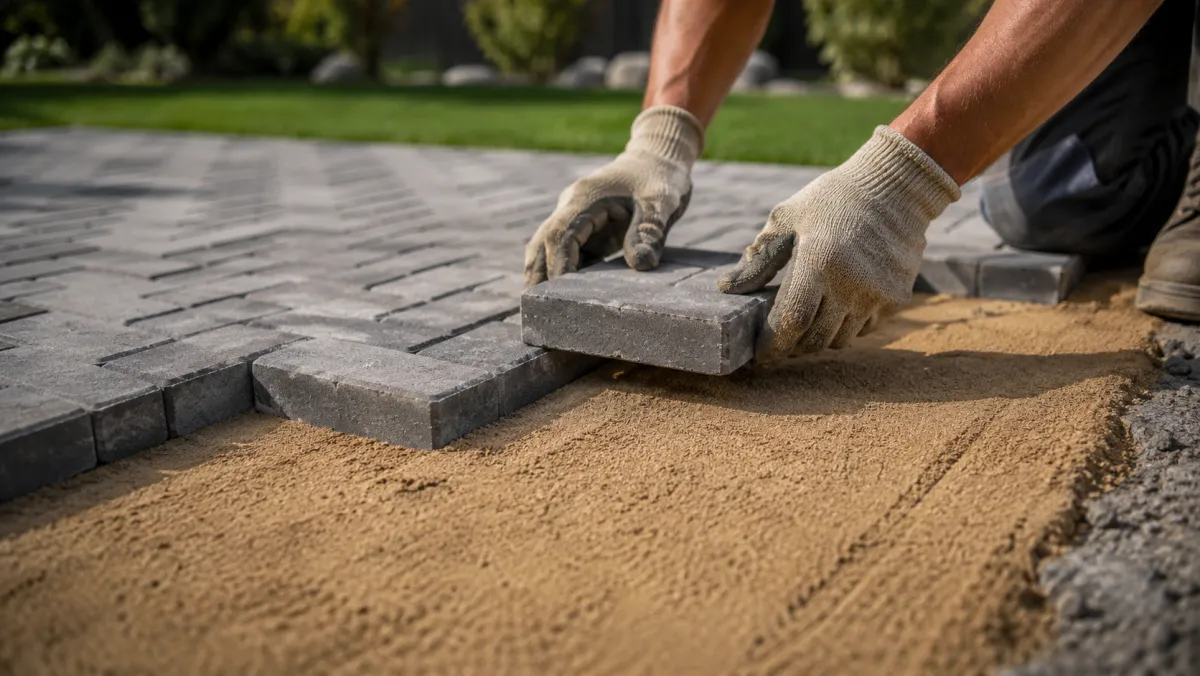
Two kinds of sand, two jobs
Before you buy anything, it helps to know that "sand for pavers" means two different materials:
- Bedding sand — a thin, level layer on which the pavers sit. It is screeded smooth and left uncompacted so the pavers seat into it.
- Jointing sand — swept into the narrow gaps between pavers after they are laid. It locks the pavers together and keeps weeds and ants out.
They are bought separately and estimated differently, so we will tackle each in turn, starting with the bedding layer, which is where most of your sand volume goes.
How much bedding sand do you need?
Bedding sand is spread about 1 inch deep across the whole area. So the volume is your area times that depth:
Cubic feet of bedding sand = area in sq ft × (1 ÷ 12)
Divide by 27 for cubic yards, which is how bulk sand is sold. To estimate weight, sand runs roughly 1.3 to 1.4 tons per cubic yard.
A worked example
Say you are building a 200-square-foot patio with a 1-inch bedding layer:
- Volume: 200 × (1 ÷ 12) = 16.7 cubic feet
- Cubic yards: 16.7 ÷ 27 = about 0.6 cubic yards
- Weight: 0.6 × 1.35 = about 0.8 tons
That is the bedding layer sorted. Most people order bedding sand in bulk by the cubic yard for anything larger than a small path, since bagged sand gets expensive fast at this volume.
Enter your area and a 1-inch depth to get your bedding sand in tons, cubic yards, and bags.
Bedding sand coverage chart
A quick reference for a 1-inch bedding layer at common patio sizes:
| Area | Cubic feet | Cubic yards | Approx. tons |
|---|---|---|---|
| 100 sq ft | 8.3 | 0.31 | 0.42 |
| 200 sq ft | 16.7 | 0.62 | 0.83 |
| 300 sq ft | 25.0 | 0.93 | 1.25 |
| 400 sq ft | 33.3 | 1.23 | 1.67 |
How much jointing sand do you need?
Jointing sand is much harder to pin to a single formula, because it depends on three things: your paver size, paver thickness, and joint width. Wider joints and thicker pavers swallow more sand.
The practical answer: check the coverage chart printed on the bag. As a rough guide, a 50-pound bag of polymeric sand often covers somewhere between about 25 and 100 square feet. Narrow joints with large pavers land at the high end, wide joints with small pavers at the low end. Buy by that chart, then add one spare bag.
What kind of sand to use
Using the wrong sand is the most common and most expensive paver mistake. Here is what each layer needs:
| Layer | Use this | Avoid |
|---|---|---|
| Bedding | Coarse, sharp concrete sand (ASTM C33) | Fine play sand, beach sand, stone dust, limestone screenings |
| Jointing | Polymeric sand (or regular joint sand) | Bedding sand, builder's sand |
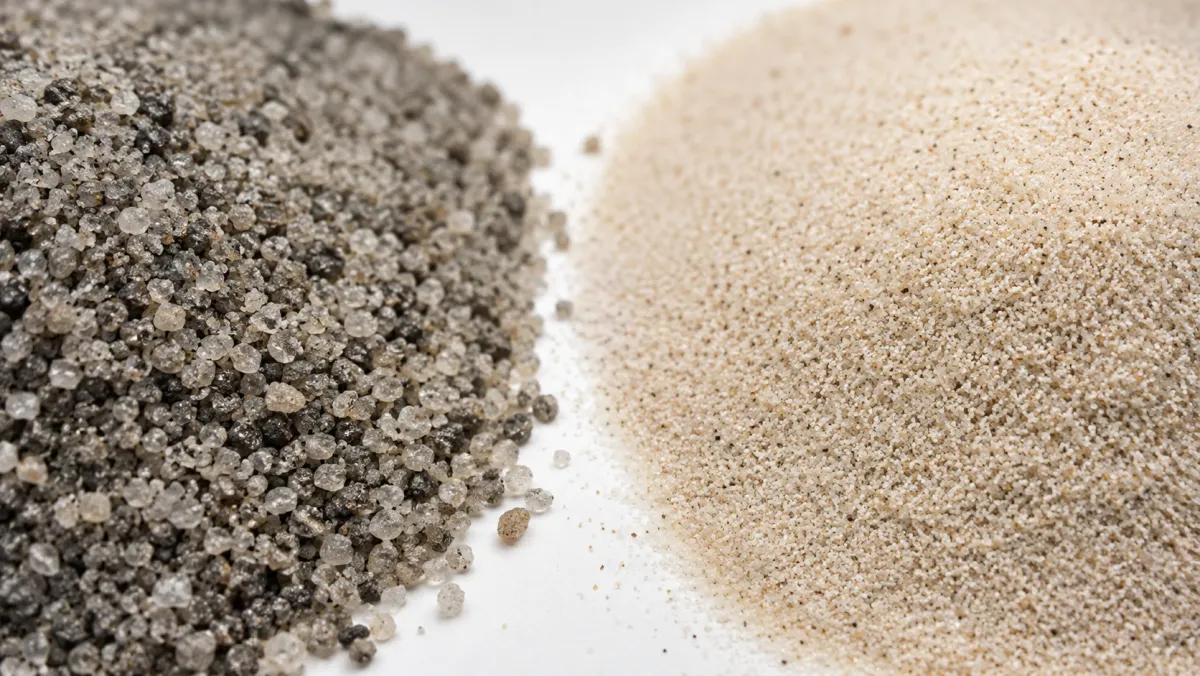
Coarse bedding sand has angular grains that lock together and drain freely. Fine or dusty material holds water, washes out, and breaks down, which is exactly how a patio starts to sink. For the joints, polymeric sand contains binders that harden when wet, so it resists weeds, ants, and washout far better than plain sand.
The layers under the sand
Bedding sand is not a base. It is a thin leveling layer, and it only works over a proper foundation. A lasting paver build is stacked like this, from the bottom up:
- Compacted soil subgrade — the excavated, tamped ground.
- Compacted gravel base — 4 to 6 inches, the part that carries the load and drains water. Size it with the gravel calculator.
- Bedding sand — the 1-inch layer this guide is about.
- Pavers — work out how many with the paver calculator.
- Jointing sand — swept into the gaps at the end.
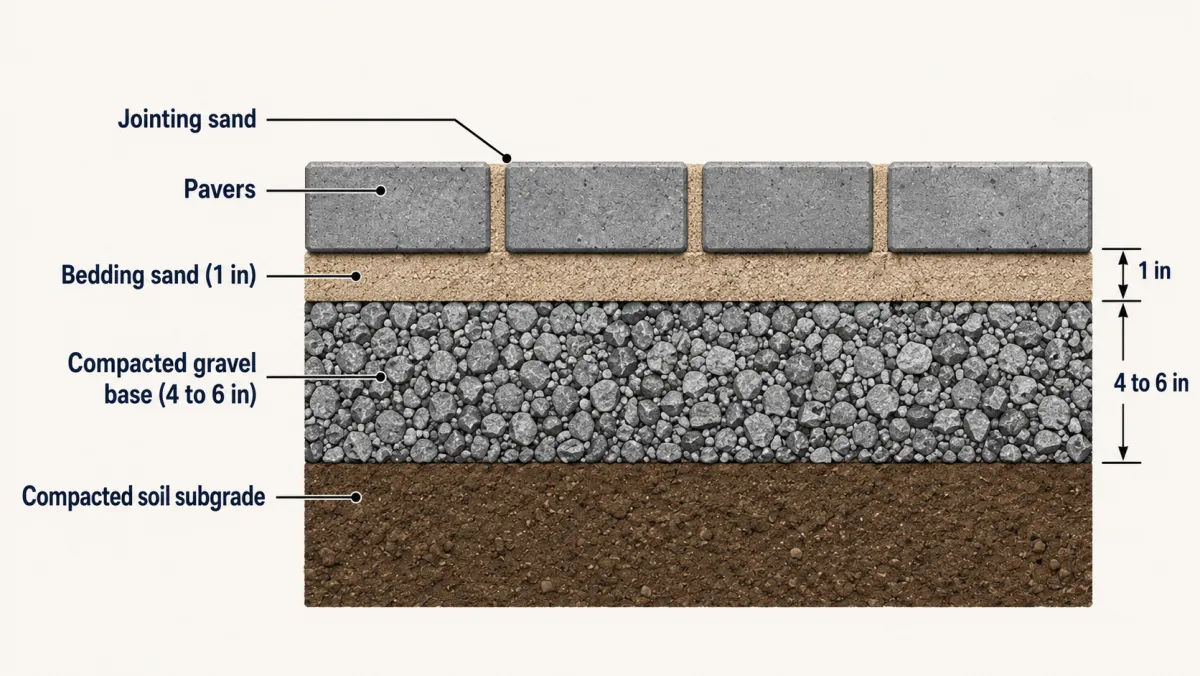
If you are planning the whole patio, our companion guide on how many pavers you need walks through the surface layer in detail.
How to spread bedding sand
Spreading the bedding layer evenly is what makes pavers sit flat. The standard method, used by the university extension guides linked below, is screeding:
- Lay two screed rails — lengths of 1-inch pipe or conduit — on the compacted base, parallel and a few feet apart.
- Spread sand between and over the rails to about 1 inch.
- Drag a straight 2×4 across the rails to strike off the excess and leave a smooth, even bed.
- Remove the rails and fill the grooves with sand.
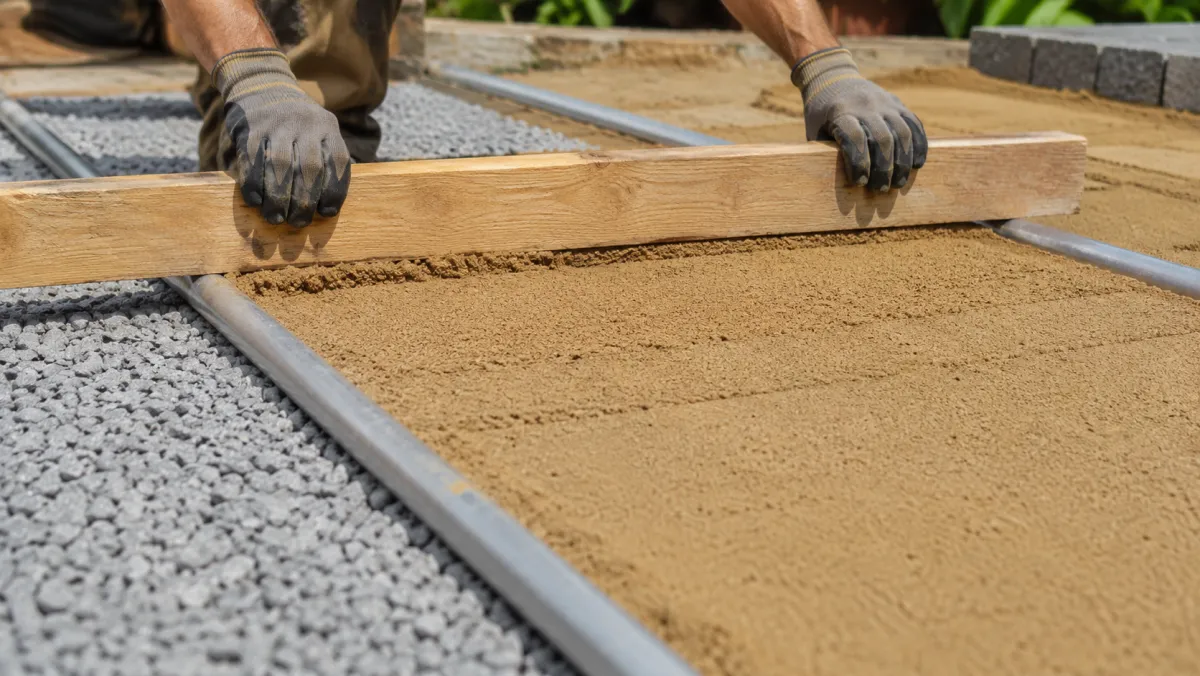
Do not compact the sand. Lay your pavers on it, then compact the whole surface at the end so the pavers seat and the joints lock.
Common mistakes
- Using sand as the base. Sand is a leveling layer, not a foundation. Skipping the gravel base is the number-one cause of sinking pavers.
- Using fine play sand. It holds water and washes out. Use coarse concrete sand for bedding.
- Making the bedding layer too thick. Stick to about 1 inch. Two or three inches lets pavers settle unevenly.
- Compacting the bedding sand before laying. Leave it loose and screeded; compact only after the pavers are down.
- Using regular joint sand and skipping the binder. Plain sand washes out and grows weeds. Polymeric sand lasts far longer.
- Ordering the exact amount. Add about 10 percent to your bedding sand for the uneven base and screeding losses.
Frequently asked questions
How much sand do I need for pavers?
For the bedding layer, multiply your area in square feet by 1/12 to get cubic feet for a 1-inch layer. A 200 square foot patio needs about 16.7 cubic feet, which is roughly 0.6 cubic yards or about 0.8 tons. Add about 10 percent extra. Jointing sand is separate and is estimated from the bag chart.
How thick should the sand layer be under pavers?
About 1 inch of bedding sand, screeded level and left uncompacted. A thicker layer of 2 or 3 inches lets the pavers settle unevenly over time.
What kind of sand do you use under pavers?
Use coarse, sharp concrete sand (ASTM C33). Avoid fine play sand, beach sand, stone dust, and limestone screenings, which hold water and wash out.
Should I use polymeric sand or regular sand for the joints?
Polymeric sand is the better choice. Its binders harden when wet, so it resists weeds, ants, and washout far better than plain joint sand.
Do you compact the bedding sand before laying pavers?
No. Leave the screeded bedding sand loose, lay the pavers on it, then compact the whole surface at the end so the pavers seat and the joints lock.
Can I use sand instead of a gravel base under pavers?
No. Sand is a thin leveling layer, not a base. Skipping the 4 to 6 inch compacted gravel base is the number-one cause of sinking pavers. See the gravel base guide for depths.
How much polymeric sand do I need for joints?
It depends on paver size, paver thickness, and joint width. A 50-pound bag often covers somewhere between about 25 and 100 square feet. Check the coverage chart on the bag, then add one spare bag.
Helpful resources
These authoritative sources offer reliable, research-based guidance on paver bedding sand and base preparation.
- Installing Concrete Pavers Source: Iowa State University Extension and Outreach. A step-by-step guide covering the concrete-sand bedding layer, why not to compact it, and which sands to avoid.
- 10-Step Guide to Installing Pavers (PDF) Source: Oregon State University Extension. Covers excavation depth, the 4 to 6 inch base, and the 1-inch sand bedding layer.
- Application Guide for Interlocking Concrete Pavements Source: Concrete Masonry & Hardscapes Association (CMHA). The hardscape industry authority on base, bedding sand, and installation standards.
Conclusion
Sand for pavers comes down to two layers: about a 1-inch bedding layer of coarse concrete sand under the pavers, and jointing sand swept into the gaps on top. Measure your area, multiply by a 1-inch depth for the bedding volume, add roughly 10 percent, and check the bag chart for jointing sand. Use coarse concrete sand below and polymeric sand in the joints, and always over a proper compacted gravel base.
When you are ready to order, run your patio size through the YardFigure Sand Calculator for the bedding layer, the gravel calculator for the base, and the paver calculator for the pavers themselves. Three quick calculations, and the whole patio is planned.
Keep planning
Related
How many pavers do I need?
Paver sizes, waste allowance, joint gaps, and the surface layer.
Read guide →How much gravel under a slab?
The compacted base under the sand, with depths by project.
Read guide →