How many pavers do I need? A step-by-step guide
To find how many pavers you need, divide your patio's area by the area one paver covers, then add a waste allowance. That's the whole formula, but the details of paver size, layout, and joints decide whether you order the right number. This guide walks through it step by step, and the paver calculator will do the arithmetic for you once you understand it.
The three steps
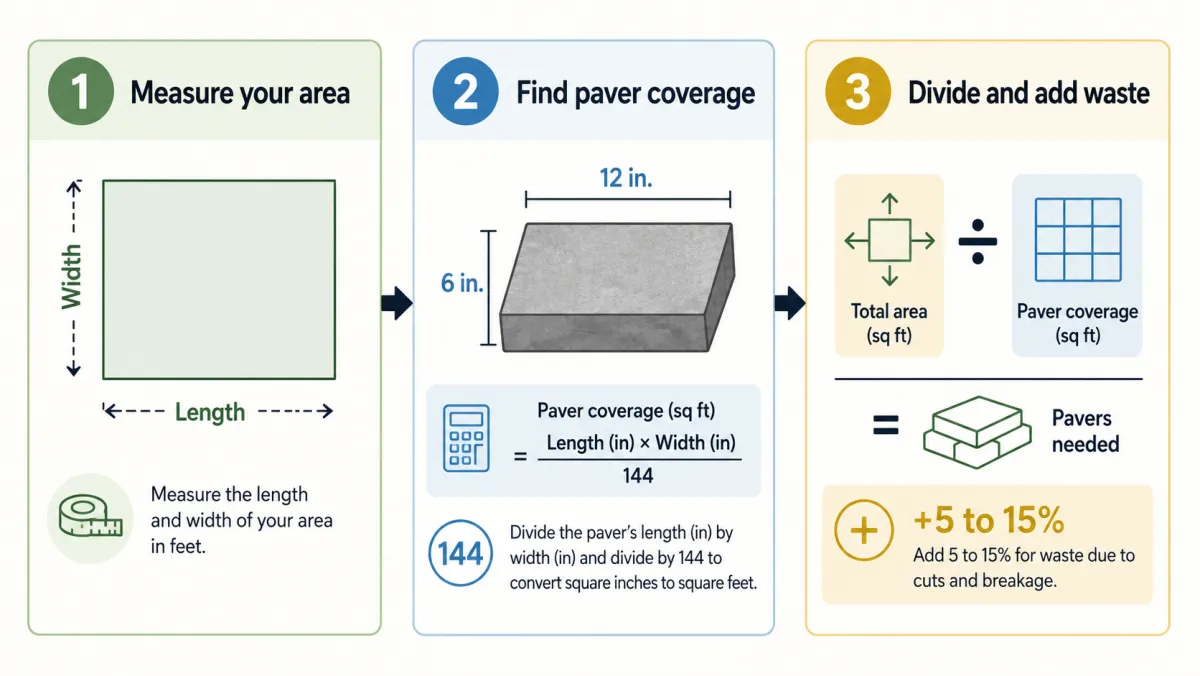
Every paver estimate, no matter the project, comes down to the same three steps:
- Measure your area. Length × width of the patio or path, in feet, gives you the square footage. For an L-shape or multiple sections, work out each rectangle and add them together.
- Find your paver's coverage. Multiply the paver's length × width (in inches) and divide by 144 to get the square feet one paver covers. A 6 × 9 inch paver, for instance, is 54 ÷ 144 = 0.375 square feet.
- Divide, then add waste. Divide your area by the paver coverage to get the base count, then add 5 to 15 percent for cuts and breakage, and round up.
A worked example
Say you're building a 12 ft × 12 ft patio with 6 × 9 inch pavers. Your area is 144 square feet. Each paver covers 0.375 square feet, so 144 ÷ 0.375 = 384 pavers. Add a 5 percent waste allowance and you'd order about 404. Swap to large 12 × 12 inch pavers (1 square foot each) and the same patio needs just 144, or about 152 with waste. Bigger pavers, fewer pieces.
Enter your area and paver size to get the exact count, waste included, in seconds.
Paver size chart
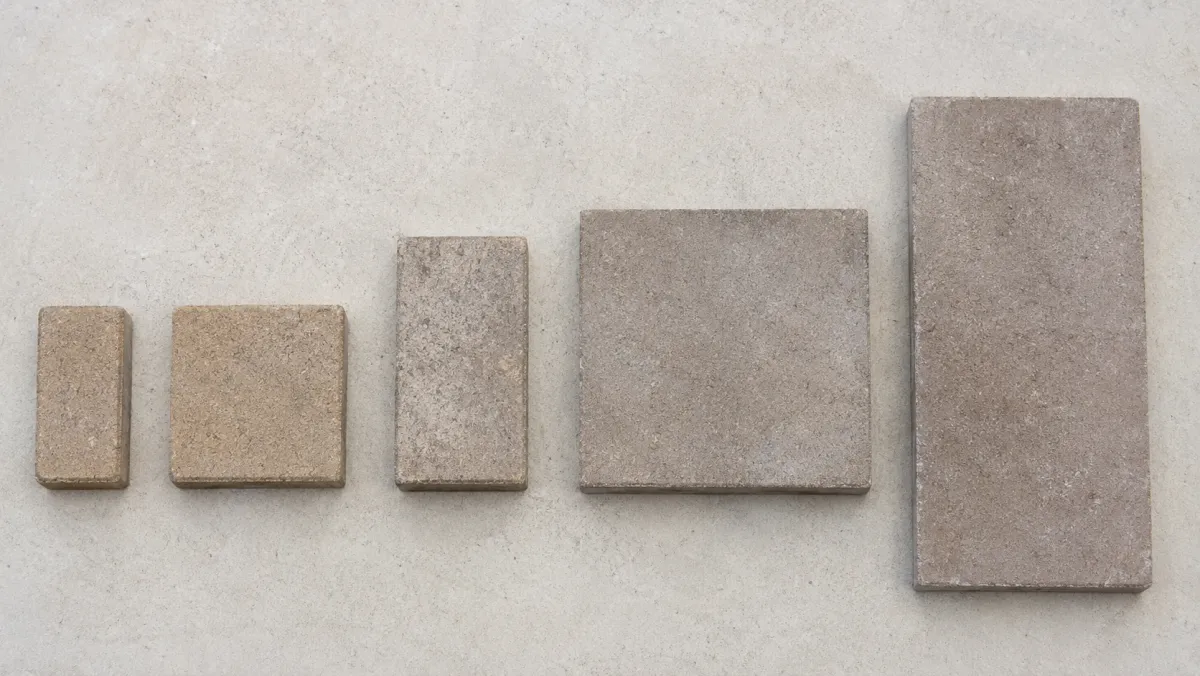
Paver size is the single biggest factor in your count. This chart shows how many of each common size you need per square foot. Multiply by your area to get a quick estimate before you fine-tune.
| Paver size | Coverage each | Pavers per sq ft |
|---|---|---|
| 4 × 8 in (brick) | 0.22 sq ft | ~4.5 |
| 6 × 6 in | 0.25 sq ft | 4.0 |
| 6 × 9 in | 0.375 sq ft | ~2.7 |
| 8 × 8 in | 0.44 sq ft | ~2.25 |
| 12 × 12 in | 1.0 sq ft | 1.0 |
| 12 × 18 in | 1.5 sq ft | ~0.67 |
| 12 × 24 in | 2.0 sq ft | 0.5 |
| 16 × 16 in | 1.78 sq ft | ~0.56 |
How much waste to add
Always order more than the bare count. Edge cuts, the odd cracked paver, and a few spares for future repairs all matter, and running short mid-job means matching a new batch that may be a slightly different shade. How much to add depends on your layout:
| Layout | Waste allowance |
|---|---|
| Straight / running bond | 5% |
| Diagonal (45°) | 10% |
| Herringbone | 10–15% |
| Circular or curved edges | 15%+ |
The more cuts a pattern needs, the more offcuts you can't reuse, which is why herringbone and circular designs run higher.
What's a joint gap, and does it change the count?
The joint gap is the small space left between pavers, later filled with jointing sand. For tight-laid pavers it's effectively zero. If you're deliberately spacing pavers, say an eighth of an inch or more, each paver effectively covers a little more ground, which slightly reduces how many you need. It's a small effect on a patio, but it adds up on big projects, so the calculator lets you enter a gap if you're using one. For most installs you can leave it at zero and rely on your waste allowance to cover the rounding.
Don't forget what goes underneath
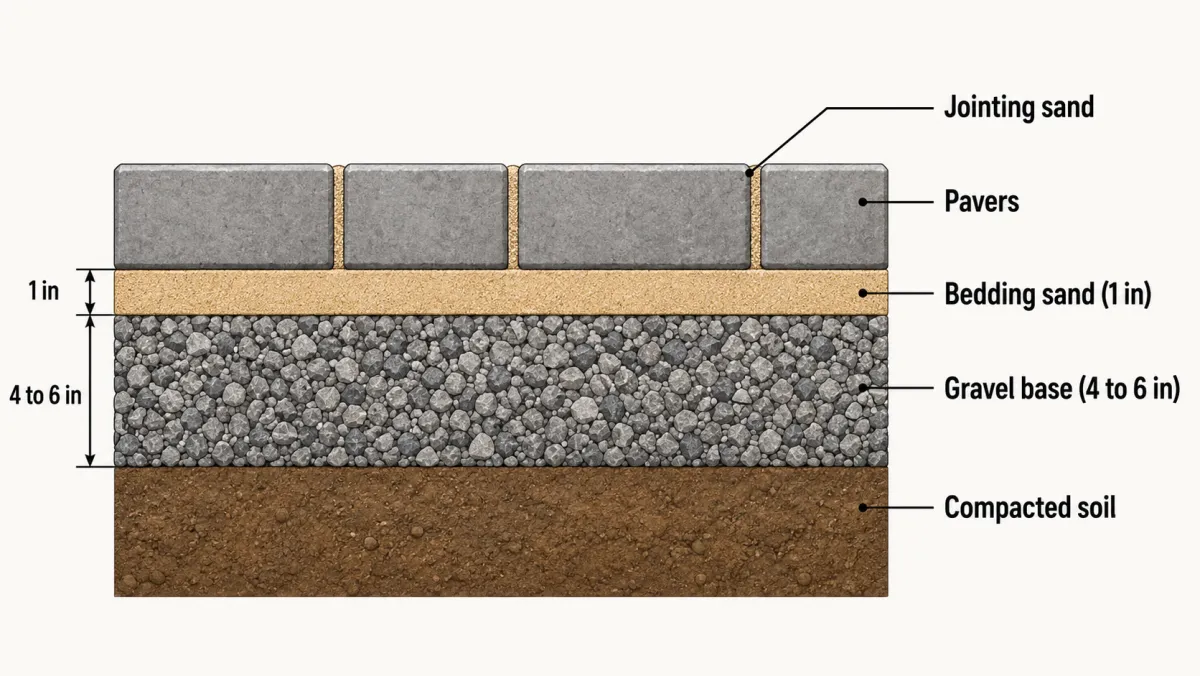
Pavers are only the visible top layer. A patio that lasts is built up in layers, and each lower layer is a separate material you'll need to estimate on its own:
- A compacted gravel base, usually 4 to 6 inches, carries the load and drains water.
- A thin bedding sand layer, about 1 inch, levels the pavers.
- Jointing sand, swept into the gaps at the end, locks everything together.
For the full build order, the right type of sand, and how the layers fit together, see our companion guide on how much sand you need for pavers.
Run your real numbers through the paver calculator, any size, any layout, waste included.
Common mistakes
- Ordering the exact count. Always add waste. A second trip to match a new batch is the classic patio headache.
- Measuring the paver without the joint. If you're spacing pavers, account for the gap so your coverage figure is right.
- Forgetting the base layers. Pavers laid on bare soil sink and shift. Budget gravel and sand too.
- Under-ordering for patterns. Herringbone and circular layouts produce far more unusable offcuts, so bump the waste up.
Frequently asked questions
How do I calculate how many pavers I need?
Find your area in square feet (length × width), find how much one paver covers (length × width in inches ÷ 144), then divide the area by the coverage and add 5 to 15 percent waste. The paver calculator does all of this automatically.
How many pavers are in a square foot?
A 12 × 12 inch paver is 1 per square foot. A 6 × 9 inch paver covers 0.375 sq ft, about 2.7 per square foot. A 4 × 8 inch brick paver needs about 4.5. Smaller pavers always mean a higher count.
How much extra should I order for waste?
5% for straight or running-bond layouts, 10% for diagonal, 10 to 15% for herringbone, and 15% or more for circular and curved designs, which need many cuts.
What goes under pavers?
About 1 inch of bedding sand over 4 to 6 inches of compacted gravel. Use the sand calculator for the bedding and the gravel calculator for the base, both separate from the pavers themselves.
How many pavers do I need for a 10x10 patio?
A 10 × 10 foot patio is 100 square feet. With 6 × 9 inch pavers (0.375 sq ft each) that is about 267 pavers, or roughly 294 with a 10 percent waste allowance. With 12 × 12 inch pavers it is 100, about 110 with waste.
Do bigger pavers mean fewer pavers?
Yes. A larger paver covers more ground, so you need fewer pieces and the install goes faster. The trade-off is that big pavers are heavier to handle and can be harder to cut around curves.
How do I calculate pavers for an L-shaped or irregular patio?
Split the area into simple rectangles, work out the square footage of each one, and add them together. Then divide by your paver coverage and add waste. Irregular and curved shapes need a higher waste allowance because they create more cuts.
Does the joint gap change how many pavers I need?
Slightly. If you deliberately space pavers, each one covers a little more ground, so you need a few less. The effect is small on a patio but adds up on big projects, so the calculator lets you enter a gap. For tight-laid pavers you can leave it at zero.
Helpful resources
These authoritative sources offer reliable, research-based guidance on estimating and installing pavers.
- 10-Step Guide to Installing Pavers Source: Oregon State University Extension. Covers measuring the area, multiplying by the paver coverage rate, and adding 5 to 10 percent for cuts.
- Application Guide for Interlocking Concrete Pavements Source: Concrete Masonry & Hardscapes Association (CMHA). The hardscape industry authority on paver layout, base, and installation standards.
- Installing Concrete Pavers Source: Iowa State University Extension and Outreach. A step-by-step guide to the base, bedding sand, and laying pavers.
Conclusion
Counting pavers comes down to three steps: measure your area, find how much one paver covers, then divide and add a waste allowance. Paver size is the biggest lever on the count, and your layout sets how much waste to add, from 5 percent for a straight bond up to 15 percent or more for curves.
When you're ready, run your real numbers through the YardFigure Paver Calculator to get the exact count with waste included. Then size the layers underneath with the sand guide, the sand calculator, and the gravel calculator, and the whole patio is planned.
Keep planning
Related
How much sand do I need for pavers?
Bedding vs. jointing sand, how much of each, and the base underneath.
Read guide →How much gravel under a concrete slab?
The base layer, the 3-step calculation, and the right gravel.
Read guide →Paver calculator
Any size, any layout, waste included, the exact count in seconds.
Open calculator →