How much mulch do I need for a flower bed? A simple guide with formula and chart
Most flower beds need a layer of mulch about 2 to 3 inches deep. To find how much that takes, multiply length × width × depth (all in feet). This guide walks through every step in plain language, gives you a chart you can copy, and shows exactly when a calculator saves you time.
Quick answer
Most flower beds need a layer of mulch about 2 to 3 inches deep. To find how much mulch that takes, use this simple formula:
Length (feet) × Width (feet) × Depth (feet) = Cubic feet of mulch
Measure your depth in inches first, then divide by 12 to turn it into feet. For example, 3 inches is 0.25 feet.
Here is a quick guide for common flower bed sizes at a 2 to 3 inch depth, using standard 2 cubic foot bags:
| Flower bed size | Depth | Cubic feet | 2 cu ft bags |
|---|---|---|---|
| Small, 4 ft × 5 ft | 2 inches | about 3.3 | 2 bags |
| Medium, 10 ft × 6 ft | 3 inches | 15 | 8 bags |
| Large, 20 ft × 10 ft | 3 inches | 50 | 25 bags |
These are estimates. Your real number depends on bed shape, the depth you choose, how settled the soil is, and the exact bag size you buy.
Use a mulch calculator when your bed is large, when it has a curved or irregular shape, or any time you want exact numbers without doing the math by hand. You can plug your measurements into the YardFigure Mulch Calculator and get cubic feet, cubic yards, and bag counts in seconds.
Short introduction
Buying mulch sounds simple until you are standing in the garden center, wondering how many bags will fit in your car and whether you guessed right. Buy too little, and you are back for a second trip with a half-finished bed. Buy too much, and you have leftover bags taking up space in the garage.
The good news is that the math takes about five minutes, and you only need three numbers: length, width, and depth. This guide walks you through every step in plain language, gives you a chart you can copy, and shows you exactly when a calculator saves you time.
What is mulch and why is it used in flower beds?
Mulch is a layer of material spread over the soil around your plants. In flower beds, it is usually an organic material like shredded bark, wood chips, or pine straw, though some people use stone or rubber mulch.
A good layer of mulch does several useful things at once. It holds moisture in the soil, so you water less often. It blocks sunlight from reaching weed seeds, so fewer weeds sprout. It keeps soil temperature steadier through hot and cold spells. As organic mulch breaks down, it also feeds the soil. And it simply makes a bed look finished and tidy.
The catch is that mulch only works well at the right depth. Too thin and it cannot do its job. Too thick and it can trap moisture against plant stems and cause problems. That is why getting the amount right matters, and why it helps to measure before you buy.
How much mulch do you need for a flower bed?
The amount of mulch you need depends on three things:
- The length of the bed
- The width of the bed
- The depth of mulch you want
Bigger beds and deeper layers need more mulch. That is the whole idea. A small 4-foot by 5-foot bed at a shallow depth might take only a couple of bags, while a long border bed could take a full pickup load.
Because every bed is different, there is no single answer that fits all yards. What stays the same is the method. Once you know your three numbers, the formula does the rest.
Simple mulch formula for flower beds
Here is the formula in the simplest form:
Cubic feet of mulch = length in feet × width in feet × mulch depth in feet
Your depth will almost always start in inches, so convert it first:
Depth in feet = depth in inches ÷ 12
If you want the answer in cubic yards, which is how bulk mulch is sold, take one more step:
Cubic yards = cubic feet ÷ 27
A worked example
Say you have a flower bed that is 10 feet long and 6 feet wide, and you want 3 inches of mulch.
- Convert the depth: 3 inches ÷ 12 = 0.25 feet
- Multiply: 10 × 6 × 0.25 = 15 cubic feet
- For cubic yards: 15 ÷ 27 = about 0.56 cubic yards
- If bags hold 2 cubic feet each: 15 ÷ 2 = 7.5, so you round up to 8 bags
That is the entire process. Multiply three numbers, then divide if you need bags or cubic yards. If you would rather skip the arithmetic, the YardFigure Mulch Calculator does all three conversions for you.
How to measure your flower bed
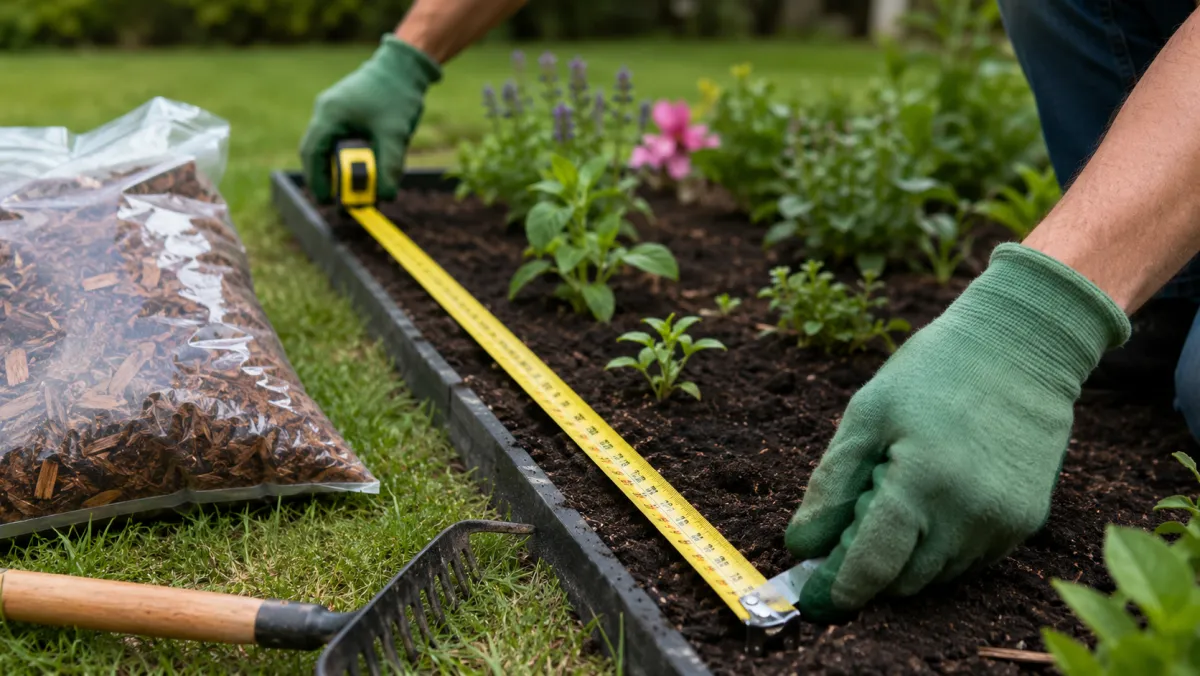
You only need a tape measure or a measuring wheel.
For a rectangular or square bed, measure the length along one long side and the width along one short side. Write both numbers down in feet.
For a long border bed, measure the full length and then the average width, since borders often narrow and widen along the way. Take a few width readings and use a middle value.
For a curved or rounded bed, you have two easy options. You can treat it as a circle and measure across the widest point to get the diameter, or you can break it into a couple of simple rectangles and measure each one — more on irregular beds in the examples below.
Take your time here. The measurement step is where most over-buying and under-buying begins.
Best mulch depth for flower beds
For most flower beds, a layer of 2 to 3 inches is the sweet spot. That is deep enough to hold moisture and slow down weeds, without burying your plants.
A few notes that change the right depth for your bed:
- Around trees and shrubs, a slightly deeper layer of 3 to 4 inches can help, but keep it pulled back from the trunk.
- If you already have old mulch in the bed, you usually only need to top it up to reach 2 to 3 inches total, not add a full new layer.
- In beds with heavy weed pressure, staying closer to 3 inches helps block more light.
- Drainage and plant type matter too. Plants that dislike wet roots do better with a lighter layer, while open soil that bakes in the sun benefits from a fuller one.
How deep should mulch be in flower beds?
Aim for 2 to 3 inches of total coverage. Going much thinner than 2 inches tends to dry out fast and lets weeds through. Going much thicker than 3 inches around delicate plants can trap too much moisture against stems. When in doubt, 3 inches is a safe target for a fresh bed.
How many bags of mulch do you need?
Bagged mulch is sold by volume, and bag sizes vary. The two most common sizes are 2 cubic feet and 3 cubic feet, so always check the label before you do the math.
To find your bag count:
Bags needed = total cubic feet ÷ bag size in cubic feet
Then round up, because you cannot buy part of a bag. Using the earlier example of 15 cubic feet:
- With 2 cubic foot bags: 15 ÷ 2 = 7.5, round up to 8 bags
- With 3 cubic foot bags: 15 ÷ 3 = 5, so 5 bags
How much does a bag of mulch cover?
A single 2 cubic foot bag covers roughly 12 square feet at 2 inches deep, or about 8 square feet at 3 inches deep. A 3 cubic foot bag covers about half again as much. Coverage drops as your depth goes up, since a deeper layer uses more material per square foot.
Mulch coverage chart for common flower bed sizes
This chart shows estimated mulch needs for typical flower bed sizes. It assumes standard 2 cubic foot bags and rounds bag counts up.
| Flower bed size | Mulch depth | Cubic feet needed | Approx. 2 cu ft bags | Approx. cubic yards |
|---|---|---|---|---|
| 4 ft × 6 ft | 2 inches | 4.0 | 2 bags | 0.15 |
| 4 ft × 8 ft | 2 inches | 5.3 | 3 bags | 0.20 |
| 5 ft × 10 ft | 3 inches | 12.5 | 7 bags | 0.46 |
| 6 ft × 12 ft | 3 inches | 18.0 | 9 bags | 0.67 |
| 10 ft × 10 ft | 3 inches | 25.0 | 13 bags | 0.93 |
These are estimates to help you plan. Your real total can shift based on the exact depth you spread, the shape of your bed, how much the mulch settles, and the bag size you buy. For an exact number for your bed, run your own measurements through the YardFigure Mulch Calculator.
Cubic feet vs cubic yards of mulch
These two units confuse a lot of first-time buyers, so here is the simple version.
- Cubic feet is how bagged mulch is measured. Bags say 2 cubic feet or 3 cubic feet on the front.
- Cubic yards is how bulk mulch is measured. When a supplier says "a yard of mulch," they mean one cubic yard.
The conversion is easy:
1 cubic yard = 27 cubic feet
So if you need 27 cubic feet of mulch, that is exactly one cubic yard. And since most bags hold 2 cubic feet, one cubic yard equals about 13.5 bags. That number is handy when you are deciding whether to buy bags or order bulk.
How many cubic feet are in a cubic yard of mulch?
There are 27 cubic feet in one cubic yard. To go from cubic feet to cubic yards, divide by 27. To go the other way, multiply cubic yards by 27.
Bagged mulch vs bulk mulch
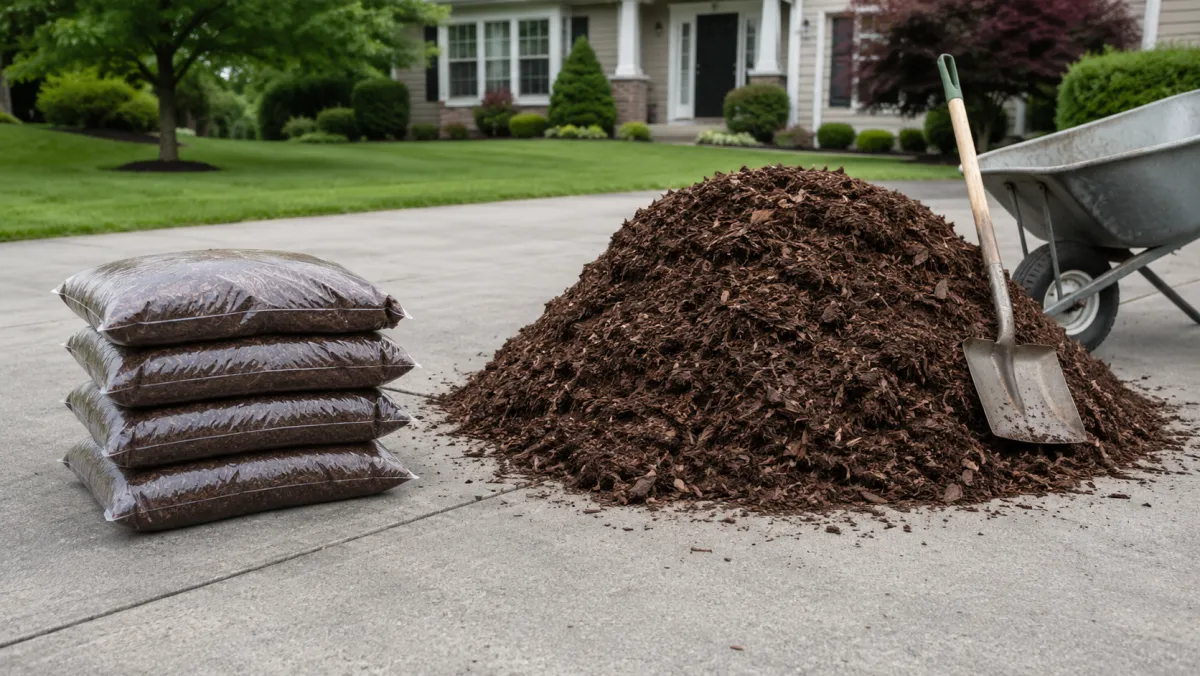
Both work fine for flower beds. The right choice usually comes down to how much you need.
Bagged mulch is easy to handle. You can carry bags to different spots in the yard, store unopened bags under cover, and spread the mulch whenever you have time. The tradeoff is that it usually costs more per cubic foot and leaves you with plastic bags to throw away.
Bulk mulch is delivered loose by the cubic yard, often dumped in your driveway. It is usually cheaper per cubic foot and creates no bag waste. The tradeoff is that you need space for the pile, a way to move it with a wheelbarrow, and the willingness to spread it fairly soon after delivery.
A rough rule of thumb: small beds that need only a handful of bags are easiest to handle with bags. Once you are looking at a couple of cubic yards or more, bulk usually saves money and effort. If you are working out soil for a planting area at the same time, the Soil Calculator can help you plan both at once.
How to use a mulch calculator for flower beds
A mulch calculator does the same math shown above, but it removes the chance of a slip and saves you the conversions. It is especially helpful for larger beds, curved beds, and anyone who would rather not multiply and divide by hand.
Here is how to use the YardFigure Mulch Calculator:
- Measure your bed length and width in feet.
- Choose your mulch depth, usually 2 or 3 inches.
- Enter the numbers.
- Read your result in cubic feet, cubic yards, and bag count.
For an irregular bed, calculate each section separately and add the results. The calculator handles the unit conversions, so you do not have to remember to divide inches by 12 or cubic feet by 27.
If your project also involves a raised planter, the Raised Bed Soil Calculator works the same way for soil volume.
Enter your bed size and depth to get cubic feet, cubic yards, and bag counts instantly.
Examples of mulch calculations
Here are four common situations worked out from start to finish.
Example 1, small flower bed
A homeowner is mulching a small front flower bed that is 4 feet by 5 feet, and wants a 2-inch layer.
- Depth: 2 ÷ 12 = 0.1667 feet
- Volume: 4 × 5 × 0.1667 = about 3.3 cubic feet
- Bags at 2 cubic feet: 3.3 ÷ 2 = 1.67, round up to 2 bags
Two bags will cover this bed with a little to spare.
Example 2, medium flower bed
A gardener is refreshing a 10-foot by 6-foot bed with old mulch and wants to bring it up to a fresh 3-inch layer.
- Depth: 3 ÷ 12 = 0.25 feet
- Volume: 10 × 6 × 0.25 = 15 cubic feet
- Bags at 2 cubic feet: 15 ÷ 2 = 7.5, round up to 8 bags
Because there is already some old mulch in the bed, the gardener may need slightly less. A quick check of how thick the old layer is helps fine-tune the count.
Example 3, large flower bed
A DIY user is mulching a long 20-foot by 10-foot bed at 3 inches.
- Depth: 0.25 feet
- Volume: 20 × 10 × 0.25 = 50 cubic feet
- Cubic yards: 50 ÷ 27 = about 1.85 cubic yards
- Bags at 2 cubic feet: 50 ÷ 2 = 25 bags
Twenty-five bags are a lot to haul and store. At this size, ordering bulk mulch by the yard is often cheaper and easier than buying bags.
Example 4, irregularly shaped flower bed
A beginner has a curved bed that does not fit a single rectangle. The simple fix is to split it into shapes you can measure.
Say the curved bed breaks down into one section about 8 feet by 4 feet and another about 4 feet by 3 feet, both at 2 inches.
- Section 1 area: 8 × 4 = 32 square feet
- Section 2 area: 4 × 3 = 12 square feet
- Total area: 44 square feet
- Volume: 44 × 0.1667 = about 7.3 cubic feet
- Bags at 2 cubic feet: 7.3 ÷ 2 = 3.67, round up to 4 bags
Because curved beds are hard to measure exactly, adding a small buffer here is smart.
How much extra mulch should you buy?
A small buffer protects you from a second trip. A common approach is to add about 10 percent to your total, then round up to the nearest whole bag.
Buy a little extra when:
- Your bed is curved or irregular and hard to measure precisely.
- The ground is uneven, and some spots will use more.
- You want a fuller 3-inch layer rather than a thin one.
You can skip the buffer when:
- Your bed is a clean rectangle you measured carefully.
- You already have old mulch that only needs topping up.
The goal is to finish in one go without ending up with a pile of unused bags.
Common mistakes when calculating mulch
A few simple errors cause most of the under-buying and over-buying. Watch for these:
- Guessing instead of measuring. Even a rough measurement beats eyeballing it.
- Using inches directly in the formula. Depth must be converted to feet first by dividing inches by 12.
- Forgetting to check the bag size. A 2 cubic foot bag and a 3 cubic foot bag give very different counts.
- Buying too little for uneven beds. Bumpy ground and curves soak up more than a flat rectangle.
- Piling mulch against plant stems. Keep mulch pulled back a couple of inches from stems to avoid trapping moisture.
- Mounding mulch against tree trunks. Avoid the volcano shape; keep mulch back from the trunk so the bark can breathe.
- Ignoring existing mulch. If a layer is already there, you usually only need to top it up.
- Treating every bed as a perfect rectangle. Split curved beds into smaller shapes instead.
- Skipping the calculator on bigger projects. For large or multiple beds, a calculator is faster and more accurate than hand math.
Tips before spreading mulch in a flower bed
A little prep makes the mulch work better and last longer.
- Weed first. Pull existing weeds before you mulch, since a shallow layer will not stop weeds that are already growing.
- Water the soil if it is very dry, so the mulch helps seal in moisture rather than sitting on dry ground.
- Spread evenly to your target depth, checking thickness as you go.
- Keep mulch off stems and trunks. Leave a small gap around the base of plants and a few inches of clearance around tree trunks.
- Rake it smooth for an even, finished look.
When to replace or refresh mulch
Organic mulch breaks down over time, which is normal and even good for the soil. As it thins, it stops blocking weeds and holding moisture as well.
Most flower beds benefit from a refresh about once a year, often in spring. Rather than dumping a full new layer on top, check the existing depth first. If you still have an inch or two, you may only need to add enough to reach 2 to 3 inches total.
If the old mulch has become matted or compacted, loosen it with a rake before adding more, so water can still soak through. You usually do not need to remove old organic mulch, since it continues to break down and feed the soil.
FAQs
How much mulch do I need for a flower bed?
Multiply the bed length in feet by the width in feet by the depth in feet. For depth, divide inches by 12 first. A 10-foot by 6-foot bed at 3 inches needs 15 cubic feet, which is about 8 bags of 2 cubic foot mulch.
How deep should mulch be in flower beds?
Most flower beds do best with 2 to 3 inches of mulch. That is deep enough to hold moisture and slow weeds without smothering plants.
How many bags of mulch do I need for a flower bed?
Divide your total cubic feet by the bag size, then round up. For 15 cubic feet using 2 cubic foot bags, that is 8 bags. Using 3 cubic foot bags, it is 5 bags.
How much does one bag of mulch cover?
A 2 cubic foot bag covers about 12 square feet at 2 inches deep, or about 8 square feet at 3 inches deep. Deeper layers cover less area per bag.
How many cubic feet are in a cubic yard of mulch?
There are 27 cubic feet in one cubic yard. To convert cubic feet to cubic yards, divide by 27.
How do I calculate mulch for an irregular flower bed?
Break the bed into simple rectangles or circles, calculate each one, then add the results. Adding a small buffer covers the rough edges.
Is 2 inches of mulch enough for flower beds?
Two inches is a reasonable minimum for most beds. It holds some moisture and blocks light, though a 3-inch layer suppresses weeds a bit better and lasts longer.
Is 3 inches of mulch too much?
Three inches is a common, healthy depth for flower beds. Just keep the mulch pulled back from plant stems and tree trunks so it does not trap moisture against them.
Should I remove old mulch before adding new mulch?
Usually no. Organic mulch breaks down and feeds the soil, so you can top it up to reach 2 to 3 inches total. If it is matted, loosen it with a rake first.
How much extra mulch should I buy?
Adding about 10 percent and rounding up to the nearest bag is a good buffer, especially for curved or uneven beds.
Is bagged mulch or bulk mulch better for flower beds?
Bags are easier for small beds and storage. Bulk is usually cheaper and less wasteful once you need a couple of cubic yards or more.
How often should I replace mulch in flower beds?
A yearly refresh, often in spring, keeps most beds looking good and working well. Check the existing depth and top up to 2 to 3 inches as needed.
Where can I calculate this automatically?
You can use the YardFigure Mulch Calculator to get cubic feet, cubic yards, and bag counts from your measurements.
Helpful resources
These trusted gardening sources offer reliable, research-based guidance on mulching. They are good places to read more about mulch types and proper use.
- Mulching Trees and Shrubs Source: University of Maryland Extension. A clear, research-based guide on choosing mulch, the right depth, and why to keep mulch away from trunks. Useful for understanding the "why" behind depth recommendations.
- Mulching Woody Ornamentals With Organic Materials Source: Oregon State University Extension Service. A peer-reviewed publication that explains mulch benefits and how to apply it correctly. Helpful for beginners who want a trustworthy overview of mulch in garden beds.
- Mulching for Soil and Garden Health Source: University of Minnesota Extension. Covers organic versus inorganic mulch and how mulch affects soil and plant health. A solid background read before you buy.
- Mulches for Home Grounds (Fact Sheet 7.214) Source: Colorado State University Extension. A practical fact sheet on mulch materials and application depth. Useful for comparing different mulch options.
Conclusion
Working out how much mulch a flower bed needs comes down to three numbers and one formula. Measure the length and width in feet, pick a depth of 2 to 3 inches, convert that depth to feet, and multiply. Divide by 27 for cubic yards or by your bag size for bag counts, then round up and add a small buffer.
Do that once, and you will buy the right amount, finish in a single trip, and skip both the second store run and the leftover pile. When you want the numbers done for you, especially for large or curved beds, run your measurements through the YardFigure Mulch Calculator and let it handle the math.
You may also find these helpful for your next project: the Raised Bed Soil Calculator and the Gravel Calculator.
Keep planning
Related
How much mulch should I put around a tree?
The right depth, the gap to leave at the trunk, and avoiding volcanoes.
Read guide →Topsoil vs. compost for raised beds
What each one does, the right ratio, and which to buy in bulk.
Read guide →